Changing the Finish on Custom Countertops After They Are Installed
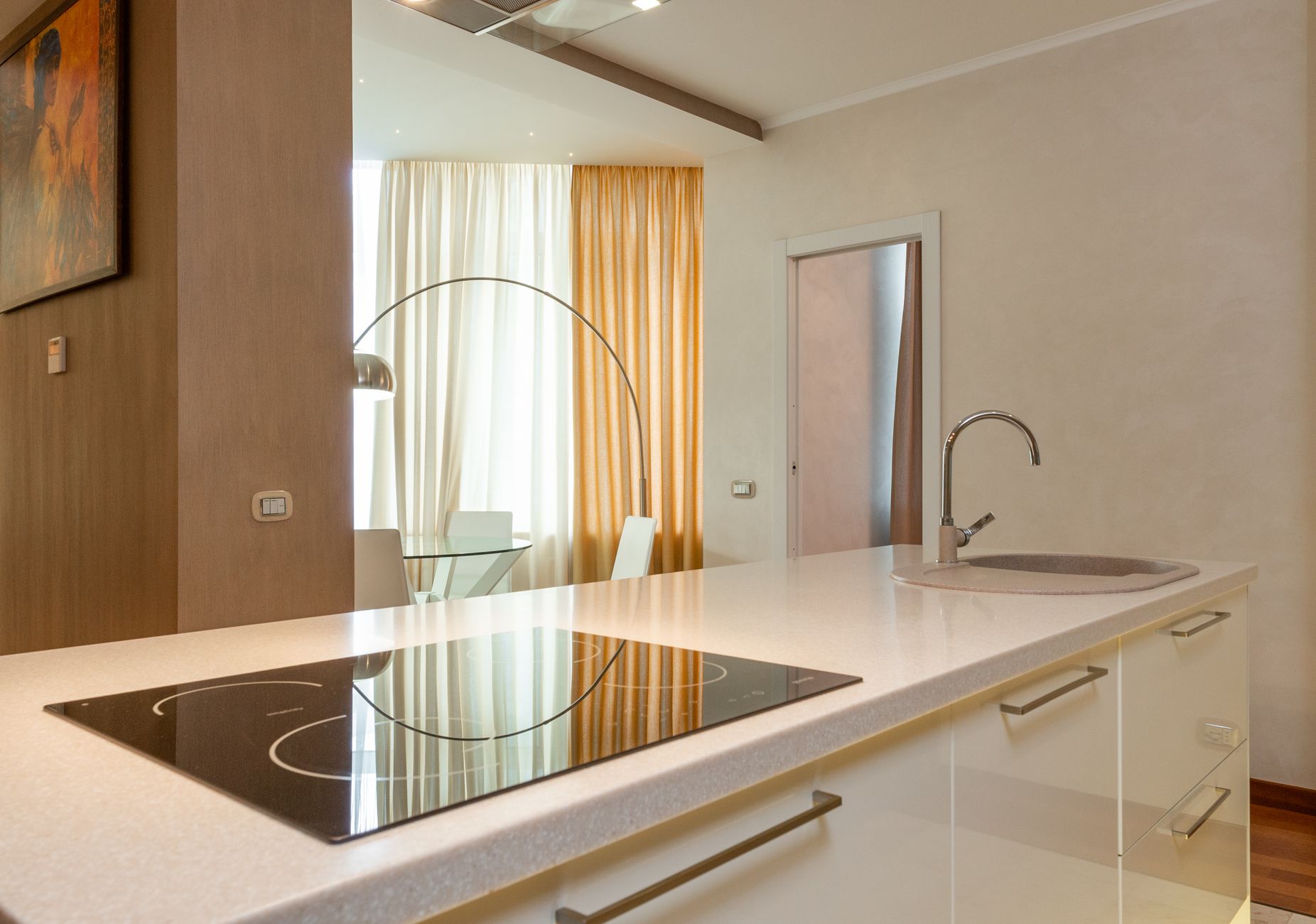
The finish on a stone top is the part everyone assumes is permanent, and it is very nearly the only part that is not. The thickness is fixed. The layout is fixed. The seam is where the fabricator put it and it is staying there. The face of the stone, though, is not a material. It is a condition, the last thing a machine did to the surface before the slab left the shop, and a machine can be asked to do something different to it later.
The calls about this tend to arrive a few years in, and they usually sound like complaints about the material when they are really complaints about the surface. Absolute black granite that shows every drop of evaporated inland hard water from across the room. A polished marble island wearing a constellation of dull rings around the coffee machine. A leathered top on a busy family counter that somebody has simply grown tired of brushing crumbs out of. In every case the owner has decided the stone was a mistake, when what they dislike is the last three hundred microns of it.
So it is worth saying plainly. The finish you chose for your custom countertops when they were new is not necessarily the finish you have to live with for the rest of the installation’s life. In natural stone, the change can usually be made in place, with the tops still bolted to the cabinets and the sink still plumbed. The rest of this is about which directions work, the one that mostly does not, and the material where the idea is off the table before it starts.
A polish is a condition of the stone, not a layer on top of it
Nothing is being stripped and nothing is being applied. A polished stone surface is the crystal faces of the material ground progressively flatter until they reflect light coherently, through a sequence of diamond abrasives that ends with grits so fine the scratch pattern falls below what an eye can resolve. On calcite stones a powder polish on a felt pad often finishes the job.
Honing is the same sequence stopped early, so the surface is flat and smooth but never made reflective. Leathering is a honed face that has then had textured brushes run over it, which opens the surface into a faint grain following the natural hardness variation of the minerals. Flaming is a torch popping the surface crystals off granite for outdoor grip.
That is the whole vocabulary, and the useful consequence is this: moving between finishes is not a coating decision, it is a question of how much material comes off and how fine the sequence ends. Which is also why each direction has a different answer.
Polished to honed is the easy direction
This is the request that works, reliably, on granite, marble, limestone, travertine and quartzite. The reflection is removed by running an intermediate grit over the whole surface and stopping. Very little material leaves the top, the process is forgiving, and a patchy result can be corrected by simply running the pad again.
It is also the change that solves the single most common complaint in a hard water region. Mineral film is visible because it interrupts a reflection. Take the reflection away and the same film is nearly invisible in the same afternoon light.
The one thing to be ready for is colour. A smooth reflective face returns light through the crystal structure and a matte one scatters it at the surface, so honed stone reads lighter, greyer and flatter than the polished version of itself, and busy granites go noticeably quieter. Splash water on a honed offcut and it looks polished again for a few minutes, which is the cheapest preview available. Ask the crew to hone a hidden area first, inside a pantry run or under the toaster, and look at it in late afternoon light before the whole kitchen is committed.
Honed back to polished is usually possible and occasionally is not
Going up is harder than going down, because a polish is only as good as the flatness underneath it and every step in the sequence has to be complete before the next one helps. Skip a grit and the result is a surface that looks glossy from directly above and shows a fine swirl at a raking angle.
A few conditions make it a poor bet. Stones carrying a lot of resin filled fissures polish unevenly, because cured resin takes gloss differently from the mineral beside it and heats faster under a pad. Granites with soft mineral inclusions can end up with the hard minerals shining and the soft ones slightly relieved. And large flat fields are the hardest part: a factory line polishes a slab against a flat bed, while a hand held machine follows whatever contour it is given, so a big island can develop a slight waviness that shows only as a distorted reflection of the window. On a long peninsula that is the thing to ask about.
Leathered back to polished is close to a one way door
This is the one to be honest about, because it is asked for often and answered vaguely.
A leathered texture is not a thin scuff on the face. It is a topography with real depth, brushed in following the hardness variation of the minerals, which means the low points sit measurably below the high points. To get to a flat polished face, every bit of material down to the lowest point of that texture has to come off the whole surface, uniformly, in place. Grind less than that and the result is a half removed texture that reads blotchy, with shiny high ground and matte hollows, and it looks worse than either finish it sits between.
The cost is also structural in a small way. Thickness leaving the top means the edge profile no longer matches the field, the reveal at an undermount sink changes, and any area already thinned around a cooktop cutout has less to give. Some crews will attempt it on a thicker slab with an obliging material. The usual honest answer is that the surface can be taken to honed fairly convincingly, and to a true polish only rarely.
Flamed surfaces sit in the same category for the same reason, and they belong outdoors anyway.
Marble that has gone dull is a repair, not a replacement
Etching on a calcite stone is a chemical change, an extremely thin layer of the mineral dissolved away by acid. The reflection goes because the flat face went. There is nothing in the mark to clean out, which is why cleaners never touch it.
Restoring it is exactly the polishing sequence, applied locally or across a panel. The trap is that the eye is very good at finding a boundary. A single ring re polished in the middle of a glossy field usually shows as a slightly different sheen with a visible edge, so the unit of repair is the whole panel, seam to seam, not the spot.
Which is why so many marble kitchens end up honed on the second pass rather than the third. The etching continues either way. On a matte field almost nobody can find it.
Engineered quartz cannot be refinished, and it fails in a specific way
This is the hard boundary, and it is worth knowing before somebody with a bag of pads offers to try.
Quartz surfacing is mineral aggregate held in a polymer resin, and its gloss is not a mechanical condition of exposed crystal faces. It is a calibrated factory face, resin rich at the very surface. Put an abrasive to it and two things happen at once: the resin at the surface is removed, exposing a duller matrix underneath, and the friction heat softens or burns the polymer that is left. The visible result is a pale cloudy patch with a hard boundary, sometimes with a slightly greasy looking smear where resin moved rather than cut. A dull spot from a hot pan, treated this way, becomes a larger and much more obvious dull spot.
There is no sequence that brings it back, because the finish was never grindable in the first place. Matte quartz blends marks a little better and still is not refinishable. On quartz the real options are a mildly abrasive cream cleaner for metal marks and surface film, a fabricator’s judgement on whether a damaged area can be cut out and a piece seamed in, or living with it.
Solid surface gets confused with quartz constantly and is the exact opposite: the same material all the way through, so it sands and repolishes by hand to an invisible result.
What a refinish day actually looks like in a finished kitchen
The work is done wet almost everywhere it is done well, because grinding stone dry throws respirable silica and because water keeps the pads cutting and the surface cool. Wet means slurry, which is a grey liquid carrying abrasive grit, and slurry is the whole logistical problem.
A competent crew masks cabinet faces and the toe kick, tapes plastic up the backsplash, lays absorbent runners over plastic on the floor, empties the cabinets directly below the work, clears the counter of the small appliances people forget, and runs a wet vacuum at the pad rather than mopping up afterwards. Slurry stains grout, marks unsealed wood and dries to a film on stainless, so the containment is not fussiness. Ask how the water is captured, not whether the crew is careful.
Two more things travel with the job. Grinding across a seam removes the colour matched epoxy at the surface, so the seam has to be refilled and re tinted afterwards or it will read as a pale line. And the edge profile, the inside face of the sink cutout and the stone around the faucet base cannot be reached by the machine doing the field, so all of it is hand worked to match. A refinished matte field carrying its original glossy edge is the most common way this job goes wrong, and it is obvious from every angle.
Expect the kitchen to be unusable for a day or two on a normal run, and expect noise and a running vacuum for most of it.
Refinish, live with it, or replace
Refinishing wins on disruption in a way that is easy to underestimate. There is no demolition, no template, no new seams, no plumbing disconnect, and above all no damage to the backsplash, which is very often the part of a countertop replacement that turns a surface job into a remodel.
What it cannot do is change the material, the pattern, the seam placement, the overhang, the edge profile or a layout that never worked. So the deciding question is what the actual complaint is. If it is about how the surface behaves, spotting, glare, visible etching, a texture that has lost its charm, refinishing addresses the real thing. If it is about the stone itself, the veining, a seam through the middle of the island, chipped edges along the run, refinishing is money spent leaving the problem where it was.
And there are cases where living with it is the right answer said out loud. Quartz, most of the time. A leathered top somebody wants mirror polished. A single etch mark on an honest working marble that will have company within the year. A top already thinned hard around its cutouts. A finish is reversible on natural stone, which is more freedom than most surfaces in a house offer, and it is still worth knowing which of the three answers you are actually buying before the plastic goes up.
Need help in Riverside?
Call (951) 686-9532